By Dr. Harrisson Ernest
December 3, 2025
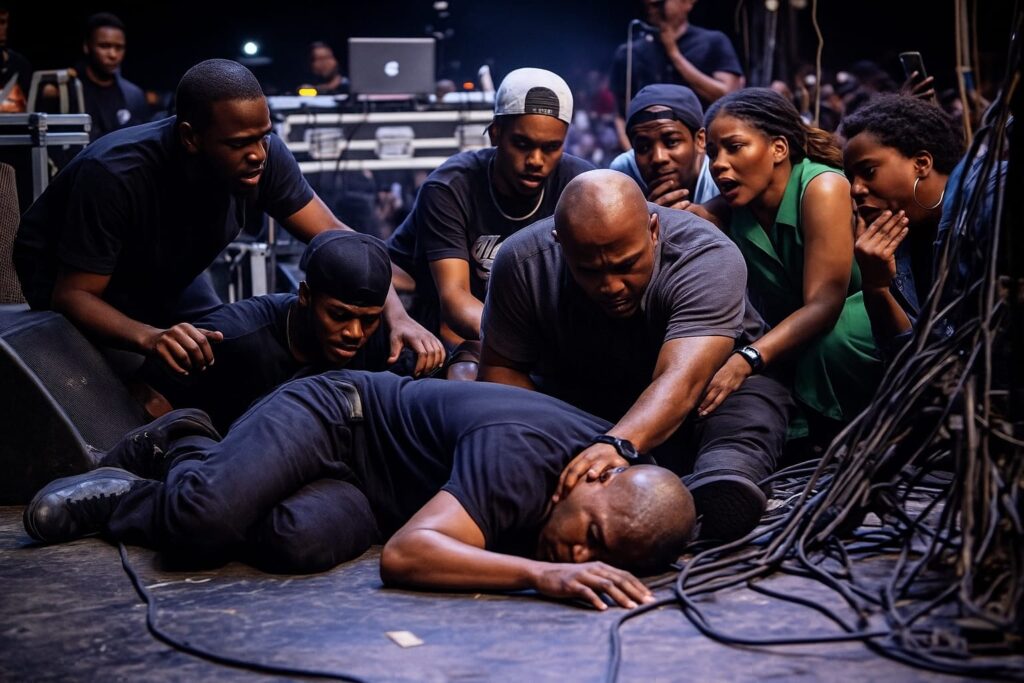
When a performer collapses, faints, or experiences respiratory distress on a stage in Haiti or within its diaspora, the audience instinctively gasps—or falls into panic. But what is most striking is not always the severity of the incident. It is the almost total absence of first-aid reflexes. The empty space around the victim, the hesitant stares, the improvised or inappropriate gestures, and crowds gathering dangerously close reveal a dramatic blind spot in Haitian society: the lack of basic first-aid training.
1 — A structural deficit visible across every sector of Haitian society
Far from being an isolated phenomenon in concert halls, the lack of first-aid reflexes is evident in the streets, in schools, on sports fields, and even within public institutions. In a country where medical emergencies are common—road accidents, injuries, cardiac events, respiratory distress, assaults—very few citizens possess the minimum skills needed to intervene during the critical first minutes, the ones that often determine survival.
The contrast is especially striking when an incident unfolds in front of thousands of spectators, filmed and broadcast in real time on social media. Images often show unconscious performers surrounded by panicked bystanders who lift or move them dangerously or attempt improvised interventions.
2 — The entertainment world as a mirror
Musical performance spaces—kompa, rap kreyòl, gospel, and others—have become places where this lack of training is impossible to ignore. Technical crews, musicians, organizers, and audiences generally lack knowledge of basic emergency actions:
checking for breathing,
protecting the victim without moving them,
avoiding abrupt movement of the neck or spine,
alerting emergency services (often nonexistent or unreachable),
performing CPR in case of cardiac arrest.
Typical reactions involve panic or risky interventions by well-intentioned spectators who “want to help” but may worsen the victim’s condition.
3 — A cultural issue, but also an institutional one
The deficit in first aid in Haiti (and in the diaspora) is not merely the result of individual behavior. It is deeply rooted in:
the absence of mandatory training in schools, universities, and workplaces;
the lack of pre-hospital infrastructure;
the near complete absence of functional ambulance services;
the lack of national awareness campaigns;
the high cost or inaccessibility of international training programs (Red Cross, NGOs, etc.).
Countries with low accidental mortality are not necessarily better equipped—they are better trained. In Haiti, this essential foundation has never been integrated into civic reflexes.
4 — The first minutes: the difference between life and death
Health professionals agree: in cases of collapse, trauma, or cardiac arrest, the first 3 to 5 minutes are decisive. When no one knows what to do, those minutes are lost—sometimes with irreversible consequences.
Even without sophisticated equipment, a series of simple actions, teachable to everyone, can stabilize a victim until an ambulance arrives (if it arrives at all). Yet in Haiti:
few people know how to perform CPR,
most are unfamiliar with the recovery position,
many still believe that “blowing air on the victim” helps,
and persistent misconceptions (giving water, massaging the feet, applying alcohol) remain widespread.
5 — Concert stages as emblematic cases
Concerts highlight the issue because they bring together three elements:
the crowd,
the cameras,
the unpredictability of performers’ physical exertion
(as in the cases of Michael Benjamin and, more recently, Pouchon Duverger).
A performer may collapse live on stage, a dancer may be injured, or a technician may be electrocuted. Yet structured responses are rarely seen:
securing the area,
clearing electrical cables,
stabilizing the head and neck,
calling a medical team on site (almost never present),
evacuating the victim on a stretcher—not by lifting them chaotically by hand.
The absence of protocol is evident—and dangerous.
6 — A shared responsibility
Event organizers have a crucial role. In most countries, an event cannot take place without:
a medical or nursing team on site,
an ambulance assigned to the venue,
an evacuation plan,
trained security personnel.
In Haiti, most major events—even those drawing thousands—operate without any emergency structure. Everything relies on improvisation, goodwill, or the belief that “God will protect.”
7 — How to address this blind spot?
Several paths exist to correct this long-standing deficit:
a) Integrate first-aid training into schools
Just as history or civic education is taught, life-saving skills should become part of the national curriculum.
b) Train artists, organizers, and technicians
A simple protocol adapted to entertainment settings could prevent tragedies.
c) Make on-site medical teams mandatory for major events
Municipalities, the Ministry of Health, and Civil Protection could enforce this requirement.
d) Launch a national awareness campaign
Radio, TV, social media, slogans, public demonstrations.
e) Develop a network of ambulances and volunteer first responders
Even at low cost, a community-based model is achievable.
A silent emergency
Ultimately, every collapse on stage, everybody lifted awkwardly by five panicked people is a painful reminder: human life often depends on simple gestures that many Haitians have not learned. As long as first aid remains a blind spot in Haitian society, stages—like streets, schools, and markets (even in the diaspora)—will continue to expose our collective vulnerabilities.
Training a population is not only about modernizing infrastructure;
it is about giving every citizen the means to save a life.
Otherwise, the emergency will remain silent in Haiti—just like insecurity.
Ouf! Haiti, a nation of oral tradition.
— Dr. Harrisson Ernest
Political analyst and commentator on governance, security, and diaspora identity
Specialist in Haitian political affairs
Physician, psychiatrist, social communicator, and jurist
harrisson2ernest@gmail.com • +1 781-885-4918 / +509 3401-6837