By Dr. Harrisson Ernest
December 21 2025
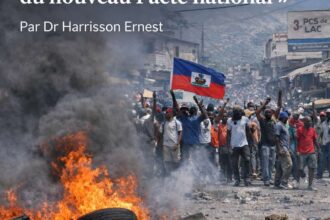
The question cuts like a sentence. It emerges after eleven months of a country holding its breath, oscillating between sustained illusions, stifled truths, and lies that have become standard political practice. As 2025 draws to a close, it leaves behind a persistent feeling: Haiti now resembles less a fragile Republic than a Republic of hypocrisies, where every actor in the collective game sustains a narrative that only stands if one agrees never to look reality squarely in the face.
The year offered no surge, no transformation, no last-minute miracle. Instead, it exposed the contradictions that undermine the State, society, and even the way Haiti conceives of itself. 2025 did not provide answers, but it pulled back the final curtains. Hypocrisies are no longer hidden; they have become public, asserted, routine.
A State That Promises Breakthroughs It Cannot Deliver
The Haitian State — or what remains of it — went through 2025 like an actor performing a role for which it had neither the script nor the means. The Transitional Presidential Council and the government multiplied declarations of intent: constitutional reform, security overhaul, judicial reorganization, economic recovery, and the holding of democratic elections. The population, for its part, has heard these promises as often as it has watched successive governments fail to deliver on them.
The real lie is not in the promises themselves; it lies in the staging. The illusion that collapse can be managed as a simple parenthesis, that a press conference, a communiqué, or international backing is enough to manufacture stability. The country is not on pause; it is fragmenting.
In 2025, the State sometimes spoke like a power, while acting like a weakened NGO.
Society sometimes pretended to believe it, for lack of any alternative narrative.
Ghost Political Parties, Still Present for the Cameras
Haiti officially counts hundreds of political parties. In practice, few exist beyond family structures, incubators of personal ambition, or façades used to negotiate with the transitional authorities and the international community.
In 2025, this hypocrisy became impossible to conceal.
The same parties that denounce the weakness of the State are incapable of organizing a congress, formulating a program, or even existing outside periods of transition.
The same leaders who speak of democracy focus on positions, not principles.
Perhaps the greatest lie of the Haitian political class is this: pretending to await elections, while many deeply fear what a genuinely free vote would reveal.
Economic Elites Between Denunciation and Complicity
The private sector, a traditional pillar of Haiti’s economy, spent 2025 denouncing insecurity, smuggling, and informality. Yet many local fortunes were built precisely on these mechanisms. Zones of lawlessness benefit certain segments of the commercial sector just as much as they destroy the middle class.
The hypocrisy is twofold:
- Entrepreneurs demand a strong State, but refuse to assume the ruptures that would make such a State possible.
- They condemn corruption, while often participating in its architecture.
The country suffocates under economic contradictions in which everyone wants change, but no one wants to pay its price.
An International Community That Preaches Sovereignty… While Pulling the Strings
If there is one arena where dissonance is glaring, it is international relations. In 2025, Haiti’s external partners multiplied calls for Haitian sovereignty, national responsibility, and local ownership of solutions. Yet these calls coexist with tight management of the transition, diplomatic pressure, and direct intervention in political choices.
Haiti lives in a paradoxical dependency:
- the international community asks the country to act like an adult,
- while holding its hand at every step.
Domestic hypocrisy consists in denouncing these interferences before cameras, then quietly begging for assistance behind closed doors. International hypocrisy lies in speaking of democracy while accommodating any arrangement that guarantees “stability.”
Media That Comment on the Shipwreck While Taking Part in It
The role of the media, once the seismograph of national life, has drifted toward active participation in the general confusion. In 2025, fabricated controversies multiplied, personal attacks were disguised as analysis, and partisan alignments were masked as neutrality.
In a Republic of hypocrisies, the media sometimes become the echo of the disinformation they claim to fight. The boundary between information and spectacle has blurred, accelerating the degradation of the public sphere.
A Society That Demands Order While Glorifying Transgression
It would be too easy to blame elites alone. Haitian society itself bears part of the lie. In 2025, the country aspired to order while applauding illegal ingenuity; demanded an end to violence while celebrating figures who defy the State; wanted laws while admiring those who circumvent them.
This contradiction lies at the heart of the Haitian tragedy: the State is weak because society has abandoned it; society abandons it because the State is weak.
2025, the Year When a Large Part of the Population Stopped Believing the Lies
The irony of 2025 is this:
Lies continue, but they no longer work.
Political discourse convinces no one.
Diplomatic narratives reassure no one.
Calls for unity within the political class ring hollow.
Media analyses (John Colem Morvan, Assad Volcy, Theriel Telus, Rudy Thomas Sanon…) lack credibility.
The false economic promises of Laurent Saint-Cyr and Alix Didier Fils-Aimé find no buyers.
A country can survive poverty, violence, and natural disasters.
It struggles to survive the moment when no one believes what everyone pretends to believe.
2025 did not close the door on lies.
It simply showed that the door no longer exists.
So, Will the Year Leave with the Keys?
This is the unsettling metaphor: if 2025 leaves with the keys, no one will be able to reopen the old cupboard of illusions. The country will face two paths:
- Break down the door before February 7, 2026: accept rupture, even if brutal; abandon the political sediments of the past; admit that transition must be transformation, not theater.
- Rebuild the house starting February 7, 2026: reconstruct a social contract through the organization of a sovereign Haitian National Conference; define what a modern Haitian State should be; rehabilitate truth as the minimal foundation of public debate.
Both options require courage, coherence, and a degree of boldness that the country has postponed for far too long.
2025 may not be the year Haiti finally closes the door on lies.
But it is the year the country stopped believing them. At the very least, it marks the first step toward an authentic reconstruction — one fortunately advocated and substantively proposed in the work of Professor Amary Joseph Noël, titled “National Conference for All”, completed and printed by Média-Texte in May 2025.
— Dr. Harrisson Ernest
Political analyst and commentator on governance, security, and Haitian diaspora identity
Specialist in Haitian political affairs
Physician, psychiatrist, social communicator, and jurist
📧 harrisson2ernest@gmail.com
📞 +1 781 885 4918 / +509 3401 6837