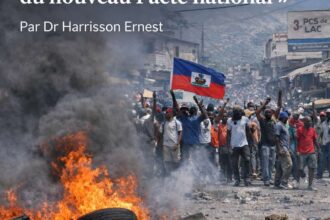
Haiti – Lost Territories: the “Anti-Kidnapping” Operation in Bel-Air Claimed by VIV ANSANM
An event to be trivialized… or a troubling turning point to be questioned?
By Dr. Harrisson Ernest – December 16, 2025
A spectacular armed operation presented as an “anti-kidnapping” action shook the Bel-Air neighborhood over the past weekend. The surprise was significant: it was not the Haitian National Police (HNP) that claimed responsibility, but the armed group VIV ANSANM—designated as a terrorist organization by the United States of America—one of several non-state entities that now control large portions of the capital, beyond so-called self-defense groups.
Many residents, caught between fear and relief, struggle to understand who is truly in command: the State or armed groups.
When armed groups act as substitutes for the State
While shocking, the incident is hardly surprising anymore.
In the absence of regular security operations by the HNP in several strategic neighborhoods of Port-au-Prince, armed groups have stepped in to fill the vacuum:
- they control entry points,
- regulate traffic,
- arbitrate disputes,
- and sometimes claim to “protect” the population from other gangs.
The intervention by VIV ANSANM thus appears to fit into a broader landscape in which armed groups have progressively appropriated core sovereign functions—justice, defense, and security—under the helpless or absent gaze of the State.
Security operation or show of force?
The group’s public, triumphalist message seems intended both to reassure Bel-Air residents and to remind the country at large that it possesses operational capacity, internal discipline, and a territory it intends to “administer.”
Three possible interpretations emerge:
- A routine occurrence in a logic of lost territories
From this perspective, Bel-Air has not been under effective State control for a long time.
A group “doing police work” is merely another stage in the ongoing process of institutional erosion.
It would represent the normalization of an anomaly.
- A troubling turning point revealing internal gang reconfigurations
An “anti-kidnapping” operation may also serve to:
- eliminate a dissident group,
- neutralize a rival,
- send a strategic signal to other armed federations,
- or reposition alliances within the capital’s constantly shifting dynamics.
In this reading, the objective would not be citizen security, but the consolidation of local domination.
- A veiled political message to the State and international partners
At a time when armed actors are closely watching the hesitations of the multinational force, the weakness of the HNP, and the absence of unified authority, VIV ANSANM may be attempting to position itself as an unavoidable interlocutor.
By demonstrating its ability to act where the State fails, the group presents itself as indispensable in any potential future negotiations.
Residents caught between forced gratitude and resigned fear
In Bel-Air, as in other areas under armed group control, residents live a cruel paradox:
- when the police intervene, they arrive late, poorly equipped, or leave quickly;
- when armed groups intervene, it is often violent—but immediately effective.
Hence the ambivalent discourse heard on the ground:
“We keep our mouths shut, but they released a group of people who had been kidnapped. What choice do we have?”
This is not trust—it is survival.
The State: absent or overwhelmed?
To date, the HNP has neither confirmed nor denied the incident. The local press has remained strikingly silent. A similar attitude is observed among human rights organizations—perhaps because this was not a massacre like La Saline.
In any case, this lack of communication fuels speculation:
- Was the police institution truly unaware?
- Did it deliberately allow the operation to avoid confrontation?
- Or does it simply no longer have the capacity to intervene in Bel-Air?
Each hypothesis reveals a painful truth:
Haiti is now managing zones where public authority exists only formally.
Should this be trivialized or should alarm bells ring?
To trivialize it is to accept that such operations are now part of the daily life of a fragmented country where the State no longer controls its territory.
To be alarmed is to recognize that each such intervention strengthens the parallel legitimacy of armed groups behaving like micro-governments.
In both cases, the signal is serious. More than a mere news item, the Bel-Air episode highlights one of the central challenges of Haiti’s crisis: the monopoly of legitimate violence—the foundation of any State—is now shared, contested, or transferred, neighborhood by neighborhood, to informally armed but practically powerful bandits.
Is this not yet another episode in Haiti’s security crisis?
Should we remain silent and pretend not to see, hear, or understand?
Only truth is justice—the democratic path and the true remedy to the corrosive suffering of the Haitian population, especially the most vulnerable residents of popular neighborhoods.
— Dr. Harrisson Ernest
Political analyst and commentator on governance, security, and Haitian diaspora identity
Specialist in Haitian political affairs
Physician, psychiatrist, social communicator, and jurist
📧 harrisson2ernest@gmail.com
📞 +1 781 885 4918 / +509 3401 6837